The merge sort algorithm is one of the most important and efficient sorting algorithms in computer science. Whether you are preparing for coding interviews, learning data structures, or implementing high-performance applications, understanding the merge sort algorithm is essential.
In this complete guide, you will learn:
- What the merge sort algorithm is
- How merge sort works step by step
- Time and space complexity analysis
- Advantages and disadvantages of merge sort
- A full C implementation of merge sort with explanation
What Is the Merge Sort Algorithm?
The merge sort algorithm is a divide and conquer sorting algorithm that works by:
- Dividing the input array into smaller subarrays
- Recursively sorting each subarray
- Merging the sorted subarrays to produce the final sorted array
Merge sort was invented by John von Neumann in 1945 and is widely used due to its guaranteed O(n log n) time complexity.
Key Characteristics of Merge Sort Algorithm
The merge sort algorithm has the following important properties:
- Time Complexity:
- Best case: O(n log n)
- Average case: O(n log n)
- Worst case: O(n log n)
- Space Complexity: O(n) (uses extra memory)
- Stable Sorting Algorithm: Maintains the order of equal elements
- Not In-Place: Requires auxiliary arrays during merging
How Merge Sort Algorithm Works (Step-by-Step)
The merge sort algorithm follows three main steps:
1. Divide
The array is recursively divided into two halves until each subarray contains only one element.
2. Conquer
Each subarray is sorted recursively.
3. Merge
The sorted subarrays are merged back together in sorted order.
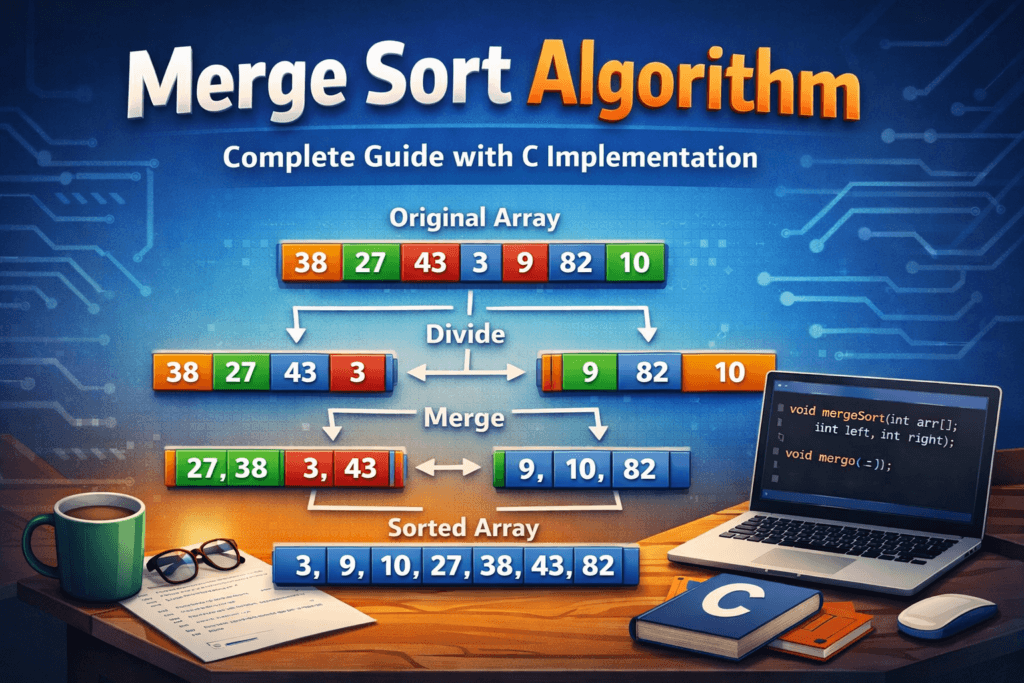
Example of Merge Sort Algorithm
Consider the array:
[38, 27, 43, 3, 9, 82, 10]
Divide Phase
[38, 27, 43, 3] | [9, 82, 10]
[38, 27] [43, 3] | [9, 82] [10]
[38] [27] [43] [3] | [9] [82] [10]
Merge Phase
[27, 38] [3, 43] | [9, 82] [10]
[3, 27, 38, 43] | [9, 10, 82]
[3, 9, 10, 27, 38, 43, 82]
Merge Sort Algorithm in C (Implementation)
Below is a complete and optimized C program for merge sort algorithm.
Merge Function in Merge Sort
void merge(int arr[], int left, int mid, int right) {
    int i, j, k;
    int n1 = mid - left + 1;
    int n2 = right - mid;

    int L[n1], R[n2];

    for (i = 0; i < n1; i++)
        L[i] = arr[left + i];
    for (j = 0; j < n2; j++)
        R[j] = arr[mid + 1 + j];

    i = 0;
    j = 0;
    k = left;

    while (i < n1 && j < n2) {
        if (L[i] <= R[j]) {
            arr[k] = L[i];
            i++;
        } else {
            arr[k] = R[j];
            j++;
        }
        k++;
    }

    while (i < n1) {
        arr[k] = L[i];
        i++;
        k++;
    }

    while (j < n2) {
        arr[k] = R[j];
        j++;
        k++;
    }
}
The merge function takes two already sorted parts of an array and combines them into one single sorted array.
👉 Important:
- Left part is sorted
- Right part is sorted
merge()just joins them in correct order
merge Function Signature (What the parameters mean)
void merge(int arr[], int left, int mid, int right)
arr[]→ original arrayleft→ starting index of the left subarraymid→ ending index of the left subarrayright→ ending index of the right subarray
So the array looks like this:
Left part:  arr[left ... mid]
Right part: arr[mid+1 ... right]
Step-by-Step Explanation
Declare variables
int i, j, k;
i→ index for left temporary arrayj→ index for right temporary arrayk→ index for original array
Find sizes of left and right subarrays
int n1 = mid - left + 1;
int n2 = right - mid;
This tells us:
n1→ number of elements in left partn2→ number of elements in right part
Create temporary arrays
int L[n1], R[n2];
Why?
👉 Because we don’t want to overwrite original data while merging.
Copy data into temporary arrays
for (i = 0; i < n1; i++)
    L[i] = arr[left + i];

for (j = 0; j < n2; j++)
    R[j] = arr[mid + 1 + j];
Example:
Original array: [3, 27, 38 | 9, 10, 82]

L[] = [3, 27, 38]
R[] = [9, 10, 82]
Reset indexes
i = 0;
j = 0;
k = left;
- Start comparing from beginning of
L[]andR[] - Start placing result from position
leftin original array
Compare and merge (MOST IMPORTANT PART)
while (i < n1 && j < n2) {
    if (L[i] <= R[j]) {
        arr[k] = L[i];
        i++;
    } else {
        arr[k] = R[j];
        j++;
    }
    k++;
}
What happens here?
- Compare smallest elements of both arrays
- Put the smaller one into
arr[k] - Move index forward
Example:
Compare 3 and 9 → put 3
Compare 27 and 9 → put 9
Compare 27 and 10 → put 10
Copy remaining elements (if any)
Left array leftovers:
while (i < n1) {
    arr[k] = L[i];
    i++;
    k++;
}
Right array leftovers:
while (j < n2) {
    arr[k] = R[j];
    j++;
    k++;
}
Why needed?
👉 Sometimes one array finishes early, but the other still has elements.
Final Result After Merge
Left:  [3, 27, 38]
Right: [9, 10, 82]

Merged array:
[3, 9, 10, 27, 38, 82]
One-Line Summary
The
merge()function combines two sorted subarrays into a single sorted array by using temporary arrays and comparing elements one by one.
Merge Sort Recursive Function
void mergeSort(int arr[], int left, int right) {
    if (left < right) {
        int mid = left + (right - left) / 2;

        mergeSort(arr, left, mid);
        mergeSort(arr, mid + 1, right);

        merge(arr, left, mid, right);
    }
}
The mergeSort function is responsible for dividing the array into smaller parts, sorting each part, and then merging them back together using the merge() function.
👉 Think of mergeSort() as the brain of the merge sort algorithm.
mergeSort Function Definition
void mergeSort(int arr[], int left, int right)
Parameters explained:
arr[]→ the array to be sortedleft→ starting index of the array/subarrayright→ ending index of the array/subarray
Step-by-Step Explanation
Base Condition (Stopping Condition)
if (left < right)
This line checks:
- If the array has more than one element, continue sorting
- If
left == right, it means only one element → already sorted
📌 This condition prevents infinite recursion.
Find the Middle Index
int mid = left + (right - left) / 2;
This splits the array into two halves:
- Left half →
lefttomid - Right half →
mid + 1toright
👉 This formula is safer than (left + right) / 2 because it avoids integer overflow.
Recursively Sort the Left Half
mergeSort(arr, left, mid);
What happens here?
- The left part is again divided
- This continues until each subarray has only one element
Recursively Sort the Right Half
mergeSort(arr, mid + 1, right);
Same process:
- Right half is divided further
- Sorting continues until smallest possible subarrays are reached
Merge the Sorted Halves
merge(arr, left, mid, right);
At this point:
- Left half is already sorted
- Right half is already sorted
👉 merge() combines both halves into one sorted subarray
How Recursion Works (Simple Example)
Array:
[38, 27, 43, 3]
Divide Phase:
mergeSort(0,3)
→ mergeSort(0,1)   mergeSort(2,3)
→ mergeSort(0,0) mergeSort(1,1) mergeSort(2,2) mergeSort(3,3)
Each single element is already sorted.
Merge Phase:
merge(0,0,1) → [27, 38]
merge(2,2,3) → [3, 43]
merge(0,1,3) → [3, 27, 38, 43]
Visual Understanding
Divide → Divide → Divide
Single elements

Merge ← Merge ← Merge
Sorted array
One-Line Summary
The
mergeSort()function recursively divides the array into smaller subarrays until one element remains, then merges them back in sorted order using themerge()function.
Why mergeSort() Is Powerful
- Guarantees O(n log n) time complexity
- Works efficiently for large datasets
- Ensures stable sorting
- Perfect example of divide and conquer
Complete Merge Sort Program in C
#include <stdio.h>

void merge(int arr[], int left, int mid, int right);
void mergeSort(int arr[], int left, int right);

void printArray(int arr[], int size) {
    for (int i = 0; i < size; i++)
        printf("%d ", arr[i]);
    printf("\n");
}

int main() {
    int arr[] = {38, 27, 43, 3, 9, 82, 10};
    int n = sizeof(arr) / sizeof(arr[0]);

    printf("Original array: ");
    printArray(arr, n);

    mergeSort(arr, 0, n - 1);

    printf("Sorted array: ");
    printArray(arr, n);

    return 0;
}
Output of Merge Sort Algorithm
Original array: 38 27 43 3 9 82 10
Sorted array: 3 9 10 27 38 43 82
Time and Space Complexity of Merge Sort Algorithm
| Case | Time Complexity |
|---|---|
| Best Case | O(n log n) |
| Average Case | O(n log n) |
| Worst Case | O(n log n) |
- Space Complexity: O(n)
- Extra memory is required for merging subarrays.
Advantages of Merge Sort Algorithm
- Guaranteed O(n log n) time complexity
- Stable sorting algorithm
- Excellent for sorting linked lists
- Ideal for external sorting (large datasets)
- Predictable performance
Disadvantages of Merge Sort Algorithm
- Requires extra memory (not in-place)
- Slower than quicksort for small arrays
- Not adaptive to already sorted data
When Should You Use Merge Sort?
Use the merge sort algorithm when:
- You need stable sorting
- Worst-case performance must be guaranteed
- Working with linked lists
- Sorting very large datasets
- Implementing parallel or distributed sorting
Conclusion
The merge sort algorithm is a foundational sorting technique that demonstrates the power of divide and conquer. Although it requires extra memory, its stability and guaranteed performance make it one of the most reliable sorting algorithms in computer science.
Mastering merge sort will strengthen your understanding of algorithms and significantly improve your performance in coding interviews and real-world applications.
👉 Next challenge: Try implementing merge sort iteratively or apply it to linked lists.
Happy coding! 🚀
See Also
- C Program to Find HCF and LCM of Two Numbers
- String Concatenation in C
- Creating a Snake Game in Python

Code is for execution, not just conversation. I focus on building software that is as efficient as it is logical. At Ganforcode, I deconstruct complex stacks into clean, scalable solutions for developers who care about stability. While others ship bugs, I document the path to 100% uptime and zero-error logic