A Beginner’s Guide to Supervised vs. Unsupervised Learning
In the world of Artificial Intelligence (AI), Machine Learning (ML) is the engine under the hood. It is the field of study that gives computers the ability to learn without being explicitly programmed. But not all machines learn the same way.
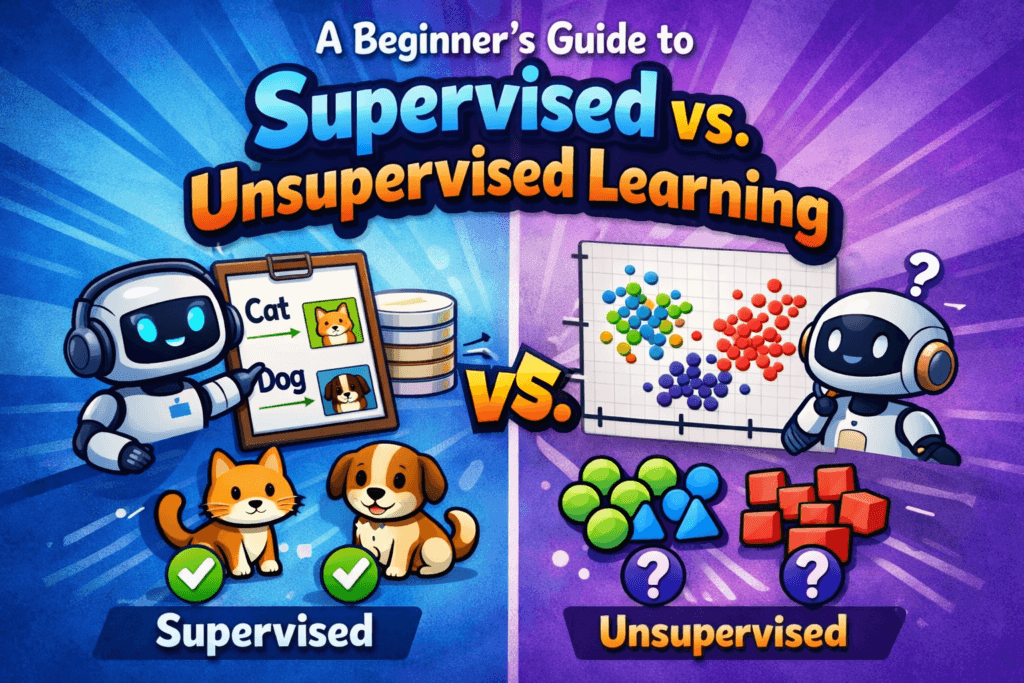
Just as humans learn differently—sometimes with a teacher correcting our mistakes, and sometimes by exploring the world on our own—algorithms follow different methodologies. The two primary pillars of this field are Supervised Learning and Unsupervised Learning.
In this tutorial, we will break down what they are, how they work, and when to use them.
Part 1: Supervised Learning (The “Teacher” Approach)
What is it?
Imagine you are teaching a toddler to identify fruits. You hold up an apple and say, “This is an apple.” You hold up a banana and say, “This is a banana.” After showing them enough examples, you show them a new apple and ask, “What is this?” If they answer correctly, they have learned.
Supervised Learning works exactly like this. It is a method where the model is trained using labeled data. “Labeled” means the data is tagged with the correct answer. The machine studies the relationship between the input (the fruit image) and the output (the name of the fruit).
How it Works
- Training Phase: You feed the algorithm a dataset containing inputs (features) and the corresponding correct outputs (labels).
- Learning: The algorithm tries to map the inputs to the outputs. It makes a guess, checks the answer key, and adjusts its internal logic to minimize errors.
- Testing Phase: You provide new, unseen data (without labels) and ask the machine to predict the outcome.
Key Categories of Supervised Learning
Supervised learning is generally divided into two types based on what you want to predict:
1. Classification (Predicting Categories)
Here, the output is a category or a label.
- Example: Is this email Spam or Not Spam?
- Example: Is the tumor benign or malignant?
- Algorithms: Support Vector Machines (SVM), Decision Trees, Logistic Regression.
2. Regression (Predicting Numbers)
Here, the output is a continuous numerical value.
- Example: Predicting the price of a house based on its square footage and location.
- Example: Forecasting the temperature for next Tuesday.
- Algorithms: Linear Regression, Polynomial Regression.
Part 2: Unsupervised Learning (The “Self-Discovery” Approach)
What is it?
Now, imagine you drop an alien onto Earth. The alien doesn’t speak our language and has no teacher. It walks into a grocery store. Even though it doesn’t know the word “Apple” or “Banana,” it can look at the produce section and separate items based on similarities. It puts the long yellow things in one pile and the round red things in another.
Unsupervised Learning involves training a machine on data that has no labels. The system is not told the “right answer.” Instead, it must figure out the structure of the data on its own.
How it Works
- Input: You feed the algorithm a massive dataset with no tags or definitions.
- Processing: The algorithm analyzes the data to find patterns, correlations, or clusters.
- Output: The machine groups the data or simplifies it based on the inherent structure it discovered.
Key Categories of Unsupervised Learning
1. Clustering (Grouping)
This involves grouping data points that are similar to each other.
- Example: Customer Segmentation. A credit card company looks at spending habits and groups customers into “Budget Shoppers,” “Luxury Travelers,” and “Tech Enthusiasts” without pre-defining those groups.
- Algorithms: K-Means Clustering, Hierarchical Clustering.
2. Association (Connecting)
This discovers rules that describe large portions of your data.
- Example: Market Basket Analysis. “People who buy bread are 80% likely to also buy milk.” This powers the “Frequently Bought Together” section on Amazon.
- Algorithms: Apriori, Eclat.
3. Dimensionality Reduction (Simplifying)
This reduces the number of variables in a dataset while keeping the important information. It’s like summarizing a long book into a short paragraph.
- Example: Compressing images without losing quality.
- Algorithms: Principal Component Analysis (PCA).
Part 3: The Comparison
To help you decide which approach to use, here is a quick comparison:
| Feature | Supervised Learning | Unsupervised Learning |
|---|---|---|
| Data Type | Labeled Data (Input + Correct Output) | Unlabeled Data (Input only) |
| Goal | To predict an outcome or future value. | To find hidden patterns or structures. |
| Feedback | Direct feedback (The model knows if it is wrong). | No feedback (The model organizes based on logic). |
| Complexity | Generally simpler to calculate but requires expensive human labor to label data. | Computationally complex, but requires less human intervention to prepare data. |
| Accuracy | Highly accurate results. | Less accurate/subjective (harder to verify). |
| Analogy | A student taking a test with an answer key. | A detective trying to solve a mystery without clues. |
Part 4: Which One Should You Choose?
The choice between supervised and unsupervised learning depends entirely on your data and your goal.
Choose Supervised Learning if:
- You have historical data where the outcome is known (e.g., past stock prices, past medical records with diagnoses).
- You have a clear question you want to answer (e.g., “Will this customer churn?”).
Choose Unsupervised Learning if:
- You have a lot of raw data but don’t know what it means yet.
- You want to explore the data to generate new ideas (e.g., “What types of users visit my website?”).
- You don’t have the budget or time to manually label thousands of data points.
Conclusion
Machine Learning is not magic; it is math applied to data. Whether you act as the teacher (Supervised) or let the machine explore on its own (Unsupervised), the goal remains the same: to turn raw data into actionable intelligence.
As you advance in your data science journey, you will also encounter Semi-Supervised Learning (a mix of both) and Reinforcement Learning (learning through rewards and punishments). However, mastering these two fundamental concepts is the first step toward building intelligent systems.
Code is for execution, not just conversation. I focus on building software that is as efficient as it is logical. At Ganforcode, I deconstruct complex stacks into clean, scalable solutions for developers who care about stability. While others ship bugs, I document the path to 100% uptime and zero-error logic