
You think you understand Java exception handling? Think again.
Most developers can explain checked vs unchecked exceptions. But senior-level interviews at top tech companies don’t care about definitions — they test behavior, execution order, and JVM edge cases.
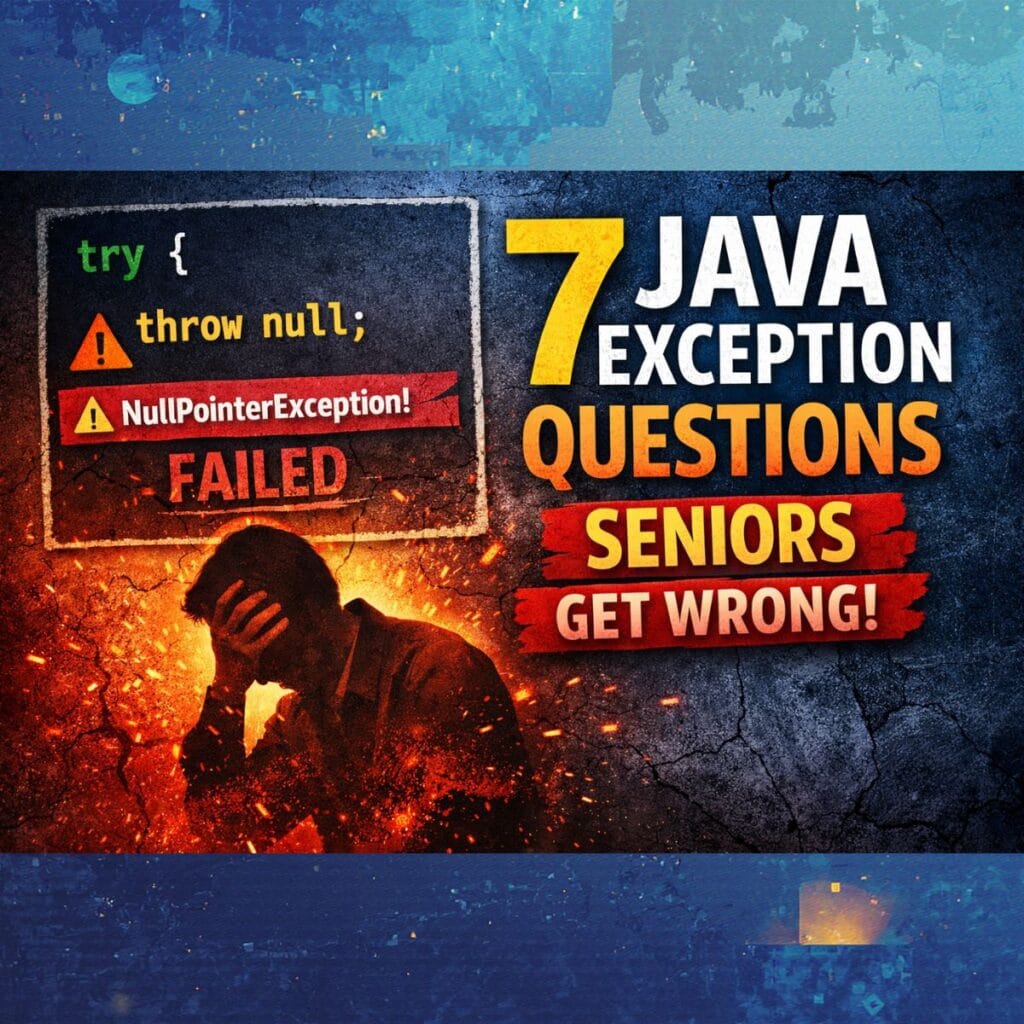
This article skips the basics and dives straight into real Java exception scenarios that regularly trip up experienced developers during interviews.
If you can confidently answer these, you’re operating at a true senior level.
1. The “Return in Finally” Trap
Question: What does this method return?
public int trickyMethod() {
    try {
        return 1;
    } catch (Exception e) {
        return 2;
    } finally {
        return 3;
    }
}
❌ Common Wrong Answer
1 — because the try block executes first.
✅ Correct Answer
3
Why?
The finally block always executes, even after a return.
If finally contains its own return, it overrides any value returned from try or catch.
Interview Insight
Returning from finally is considered bad practice because it:
- Swallows exceptions
- Makes control flow confusing
- Breaks debugging expectations
That’s exactly why interviewers love this question.
2. The System.exit() Curveball
Question: Will finally execute here?
try {
    System.out.println("Inside Try");
    System.exit(0);
} finally {
    System.out.println("Inside Finally");
}
✅ Answer
No, the finally block will not execute.
Why?
System.exit(0) terminates the JVM immediately.
The JVM shuts down before the current thread can reach finally.
💡 This is one of the very few legitimate exceptions to the “finally always runs” rule.
3. What Happens If You throw null?
throw null;
✅ Answer
It throws a NullPointerException.
Why?
The throw keyword requires a valid Throwable object.
Throwing null causes the JVM to attempt to access a non-existent object — triggering an NPE at runtime.
This is a favorite trick question because it looks harmless but reveals JVM-level understanding.
4. StackOverflowError: Exception or Error?
Question: Can you catch a StackOverflowError? And should you?
✔ Can you catch it?
Yes. It extends Throwable.
❌ Should you catch it?
Generally, no.
The Nuance
StackOverflowError is an Error, not an Exception.
Errors indicate serious JVM-level failures (like OutOfMemoryError) that applications are not expected to recover from.
Knowing the difference shows architectural maturity.
5. The “Swallowed Exception” Problem (Java 7+)
Question: How does Java handle multiple exceptions in try-with-resources?
Scenario
- The
tryblock throws an exception - The
close()method of a resource also throws an exception
❌ Old Behavior (try–finally)
The exception from close() would overwrite the original exception — losing valuable debugging information.
✅ Java 7+ Behavior (try-with-resources)
- The exception from the
tryblock becomes the primary exception - The exception from
close()is suppressed - Suppressed exceptions are attached to the primary exception
You can access them using:
exception.getSuppressed();
Interview Tip
Mentioning exception suppression instantly signals senior-level Java knowledge.
6. Checked Exceptions Inside Lambdas
Question: Why does this code fail to compile?
List<String> files = Arrays.asList("a.txt", "b.txt");

files.forEach(file -> {
    throw new IOException();
});
✅ Answer
Java’s functional interfaces (like Consumer) do not declare checked exceptions.
Because of this:
- You cannot throw checked exceptions directly inside lambdas
- You must either:
- Catch and handle them
- Or wrap them in an unchecked exception (
RuntimeException)
This limitation surprises many developers during interviews.
7. Checked vs Unchecked Exceptions (The Architectural Answer)
Question: When should you create a custom checked exception vs unchecked?
❌ Weak Answer
“Checked exceptions are mandatory, unchecked are optional.”
✅ Senior-Level Answer
It depends on recoverability.
Use Checked Exceptions When:
- The caller can reasonably recover
- The failure is expected and actionable
Example:RetryableNetworkException
Use Unchecked Exceptions When:
- The issue is a programming error
- Recovery isn’t possible at runtime
Example:InvalidConfigurationException,NullPointerException
Interviewers care more about why than what.
Final Takeaways for Interviews
finallyalmost always wins — except withSystem.exit()- Returning from
finallyis dangerous but interview-popular - Java suppresses exceptions intelligently in
try-with-resources - Lambdas and checked exceptions don’t mix well
- Exception design is an architectural decision, not a syntax one
Preparing for a Senior Java Interview?
Save this article and test yourself by predicting outputs before reading explanations.
If the “return in finally” behavior surprised you, share this with another Java developer — it might save them in their next interview.
Good luck 🚀
Code is for execution, not just conversation. I focus on building software that is as efficient as it is logical. At Ganforcode, I deconstruct complex stacks into clean, scalable solutions for developers who care about stability. While others ship bugs, I document the path to 100% uptime and zero-error logic