DeepSeek V4 moved from rumor to official release in 2026. DeepSeek announced the V4 family on April 24, 2026, with V4-Pro and V4-Flash, open-weight availability, API access, and a stated 1M-token context length. This updated guide focuses on the information developers can verify from DeepSeek’s official materials and on the engineering trade-offs that matter when evaluating the model.
Earlier versions of this article contained pre-release expectations and community speculation. Those details are now separated from the current release information because model capabilities, model names, and API behavior can change after launch.
What Is DeepSeek V4?
DeepSeek V4 is a model family from DeepSeek that includes V4-Pro and V4-Flash. DeepSeek describes the release as a long-context model family designed for reasoning and agentic workloads, with APIs that support OpenAI- and Anthropic-compatible interfaces.
DeepSeek V4 Release Timeline
| Date | Event |
|---|---|
| April 24, 2026 | DeepSeek announced V4-Pro and V4-Flash and published the V4 preview and open-weight materials. |
| July 24, 2026 | DeepSeek’s legacy deepseek-chat and deepseek-reasoner model names were scheduled for retirement. |
| September 2026 | DeepSeek’s official site lists later V4-family updates, including V4.1-Flash. |
DeepSeek V4-Pro vs V4-Flash
| Characteristic | V4-Pro | V4-Flash |
|---|---|---|
| Total / active parameters | 1.6T total / 49B active | 284B total / 13B active |
| Primary positioning | High-capability reasoning and agentic workloads | Faster and more economical V4 option |
| Context | 1M tokens | 1M tokens |
| API | OpenAI- and Anthropic-compatible interfaces | OpenAI- and Anthropic-compatible interfaces |
The exact model name used in an application should always be checked against the current API documentation. DeepSeek’s API documentation has changed its recommended model naming over time as new V4-family releases have appeared.
1M-Token Context: Why It Matters
DeepSeek states that 1M-token context is the standard across its official V4 services. A large context window can be useful for long documents, repository analysis, agent traces, and multi-file coding tasks because more relevant information can remain available within one request.
However, a large context limit is not automatically better for every application. Sending unnecessary material increases memory usage, latency, and potentially cost. Retrieval, summarization, and context selection can still be useful even when the model supports very long prompts.
Architecture and Efficiency
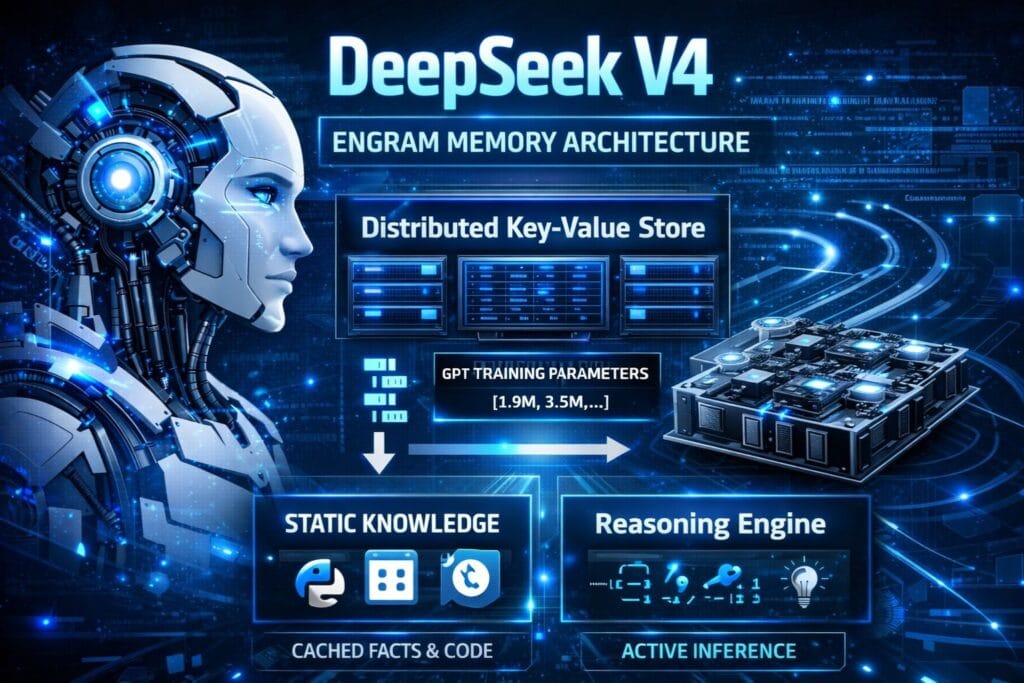
DeepSeek’s V4 materials highlight new attention and context-efficiency techniques, including token-wise compression and DeepSeek Sparse Attention (DSA). The engineering goal is to make very long context practical without scaling compute and memory linearly with the full prompt length.
Coding and Agentic Workloads
DeepSeek positions V4 for agentic and coding use cases. For a developer, that means the model can be evaluated on tasks such as repository exploration, code generation, debugging, refactoring, test creation, and multi-step tool use.
Do not judge coding quality from one demo. Build a representative test set containing the languages, frameworks, repository sizes, error cases, and tool calls used by your team. Measure correctness, test pass rate, latency, token consumption, and failure recovery.
API Compatibility
DeepSeek documents OpenAI-compatible and Anthropic-compatible API interfaces. This can reduce integration work for applications that already use one of those SDK patterns, although the exact supported parameters and model names still need to be checked against the current DeepSeek API documentation.
Base URL (OpenAI-compatible):
https://api.deepseek.com

Model names and compatibility:
Check the current DeepSeek API documentation
before deploying to production.
How DeepSeek V4 Fits Into a Developer Stack
| Use Case | Possible Integration |
|---|---|
| Coding assistant | Terminal agent or IDE integration |
| Long-document analysis | Large-context prompt or retrieval pipeline |
| RAG | Retriever + V4 model for grounded generation |
| Agents | Tool calling and multi-step workflows |
| Backend AI service | OpenAI-compatible SDK pattern or direct HTTP |
DeepSeek V4 vs Other Frontier Models
It is tempting to summarize model comparisons as “which model is best,” but that hides important differences. A useful comparison should specify the exact model version, benchmark, prompt format, tools enabled, context length, hardware or hosted environment, and cost assumptions.
- Coding: compare repository-level tasks, tests, debugging, and tool use.
- Long context: compare accuracy as context grows, not only the maximum context number.
- Latency: measure time to first token and total completion time.
- Cost: measure cost per successful task rather than only price per token.
- Reliability: track retries, tool-call failures, and unsupported answers.
Security and Production Considerations
- Do not send secrets, credentials, or private source code unless the data-handling policy allows it.
- Use authentication and authorization around internal AI services.
- Review current API pricing, limits, and supported models before deployment.
- Log enough information to debug failures without storing unnecessary sensitive data.
- Keep model configuration versioned so evaluation results can be reproduced.
What Changed From the Original Pre-Release Expectations?
Before launch, community discussions included predictions about release timing, multimodal support, architecture, and benchmark improvements. Those predictions should not be presented as confirmed product specifications. The release itself provides a much better basis for analysis: official model names, published technical material, API behavior, and measurable results from real workloads.
Current Official References
- DeepSeek V4 official announcement
- DeepSeek API documentation
- DeepSeek Transparency Center
- DeepSeek V4.1-Flash announcement
Final Thoughts
DeepSeek V4 is best understood as a model family built around long-context processing, efficiency, reasoning, and agentic use cases. Its practical value depends on the exact model variant and workload. For developers, the most useful next step is to test it against your own tasks and compare quality, latency, cost, and operational behavior with the alternatives you already use.