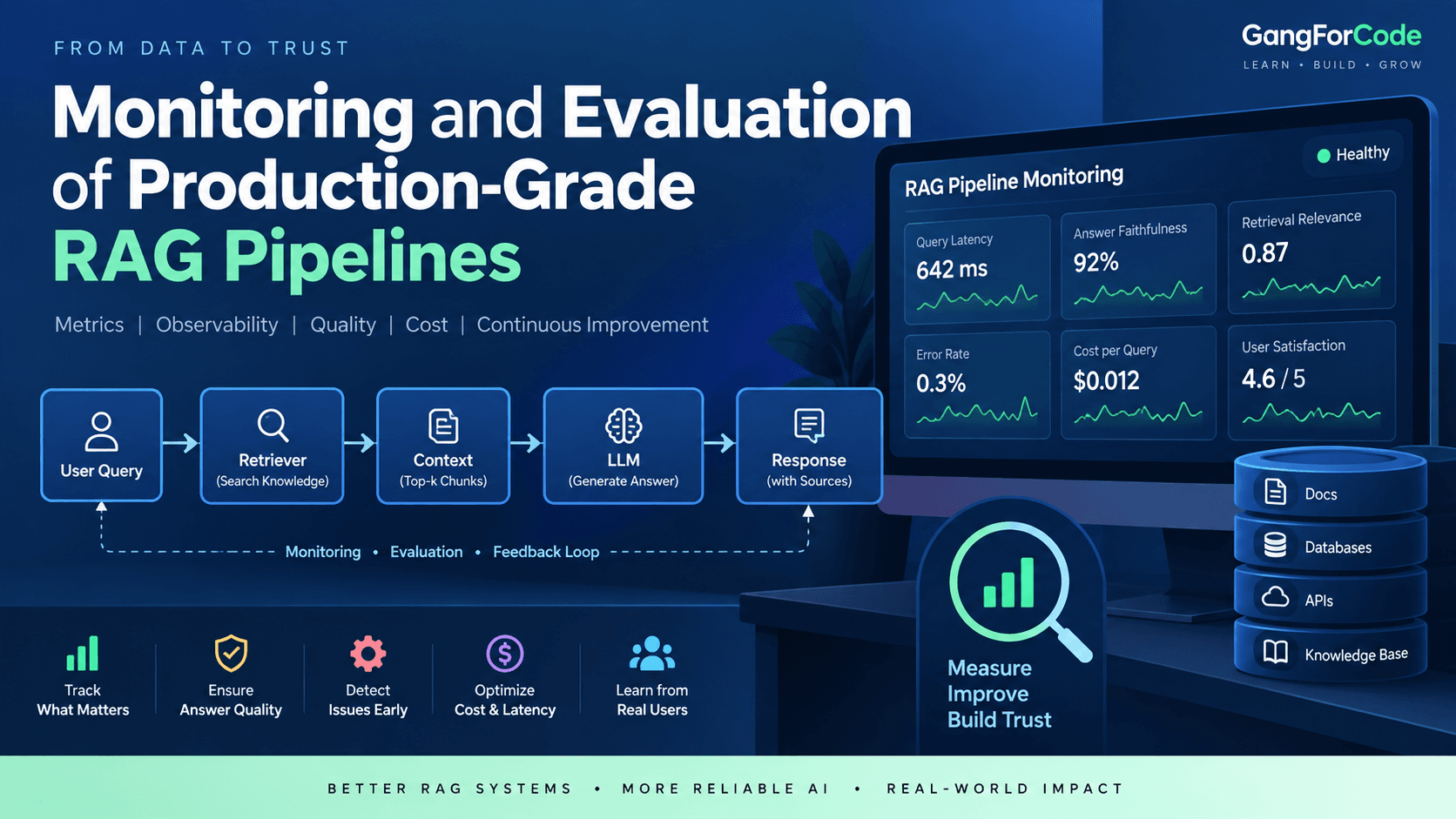
Building a Retrieval-Augmented Generation (RAG) prototype is relatively easy. Making that RAG system reliable in production is much harder. A production-grade RAG pipeline must be monitored for retrieval quality, answer faithfulness, latency, cost, data freshness, failures, and user satisfaction.
This guide explains how to monitor and evaluate a production-grade RAG pipeline, from document ingestion and retrieval to reranking, LLM generation, citations, observability, regression testing, and continuous improvement.
Table of Contents
What Is a Production-Grade RAG Pipeline?
A typical RAG application retrieves relevant information from a knowledge base and gives that information to an LLM before generating an answer.
User Query
    ↓
Query Processing
    ↓
Embedding / Query Understanding
    ↓
Retriever
    ↓
Reranker
    ↓
Context Construction
    ↓
LLM
    ↓
Answer + Citations
    ↓
Evaluation + Feedback
In production, this pipeline has two related but different concerns: monitoring tells you what is happening in the live system, while evaluation tells you how good the system’s answers are.
Monitoring vs Evaluation in RAG
| Area | Monitoring | Evaluation |
|---|---|---|
| Purpose | Detect production behavior and failures | Measure answer and retrieval quality |
| Examples | Latency, errors, tokens, cost | Recall, faithfulness, relevance |
| Frequency | Continuous | Before and after changes; optionally continuous |
| Data | Production telemetry | Golden datasets, sampled production queries |
The Four Layers of RAG Evaluation
- Retrieval: Did the system find the right documents?
- Context: Does the retrieved context contain the information required to answer?
- Generation: Is the answer relevant and supported by the context?
- End-to-end: Did the user receive a useful, correct, timely, and economical answer?
1. Evaluate Retrieval Quality
Retrieval is the foundation of RAG. If the correct information is never retrieved, even a powerful LLM cannot reliably produce the right answer.
Recall@K
Recall@K measures whether the relevant document or evidence appears in the top K retrieved results. Track values such as Recall@1, Recall@5, and Recall@10. Recall is especially important when missing the correct document makes the final answer impossible.
Precision@K
Precision@K measures how much of the retrieved set is actually relevant. High recall with poor precision can flood the prompt with irrelevant information, increasing cost, latency, and the chance of confusing the model.
MRR and NDCG
Mean Reciprocal Rank (MRR) focuses on the position of the first relevant result. Normalized Discounted Cumulative Gain (NDCG) evaluates ranking quality while giving more importance to highly relevant results appearing near the top.
2. Evaluate Chunking and Embeddings
Retrieval quality depends heavily on how documents are split into chunks and embedded. Test different chunk sizes, overlap strategies, semantic boundaries, and embedding models against your own domain-specific evaluation set.
| Change | What to Measure |
|---|---|
| Chunk size | Recall, precision, context size |
| Chunk overlap | Recall and duplicate retrieval |
| Embedding model | Recall@K, latency, cost |
| Distance metric | Ranking quality |
3. Evaluate Reranking
Many production systems use a two-stage architecture: a fast retriever produces a larger candidate set, then a reranker selects the most useful documents. Monitor retrieval recall before reranking and ranking quality after reranking so you can identify which stage is responsible for failures.
Query
  ↓
Vector / Hybrid Search → Top 50
  ↓
Reranker → Top 5
  ↓
LLM
4. Evaluate Context Quality
Retrieving a related document does not necessarily mean that the context answers the question. Measure context relevance, context precision, and context recall. For multi-document questions, verify that all important facts needed for the answer are present in the retrieved context.
5. Measure Answer Relevance
An answer can be fluent and grammatically correct while still failing to answer the user’s question. Answer relevance evaluates whether the generated response directly addresses the requested information.
6. Measure Faithfulness and Hallucinations
Faithfulness asks whether claims in the generated answer are supported by the retrieved context. This is one of the most important RAG quality signals because a successful HTTP request can still produce an unsupported answer.
Context:
"Customers can request a refund within 30 days."

Generated answer:
"Customers can request a refund within 60 days."

Result:
Unsupported claim → Faithfulness failure
For high-risk use cases, combine automated faithfulness checks with human review rather than relying on a single evaluator.
7. Evaluate Citations
If your RAG application returns citations, measure more than citation presence. A citation should actually support the claim it is attached to. Useful signals include citation coverage, citation correctness, and citation completeness.
8. Build a Golden Evaluation Dataset
A golden dataset is a curated set of representative questions with expected answers, evidence, or relevant document identifiers. Include easy questions, multi-hop questions, ambiguous questions, and negative questions where the correct behavior is to say that sufficient information is unavailable.
{
  "question": "How long is the refund period?",
  "expected_answer": "Customers can request a refund within 30 days.",
  "relevant_documents": ["refund-policy.pdf"]
}
Keep this dataset versioned. It becomes the regression test suite for your RAG system.
9. Use Production Queries for Evaluation
Synthetic test cases are useful, but real production queries reveal failure modes that developers may not anticipate. Sample anonymized queries, their retrieved documents, generated answers, feedback, latency, and token usage. Turn recurring failures into new evaluation cases.
10. LLM-as-a-Judge
An evaluator LLM can score answer relevance, faithfulness, completeness, and citation quality at scale. Treat LLM judges as measurement tools rather than absolute truth because evaluators can also make mistakes. For important systems, combine automated judging with human evaluation.
11. Monitor RAG Latency
Measure latency separately for query processing, embedding, retrieval, reranking, LLM generation, and total request time. Track P50, P95, and P99 latency. Tail latency is especially important for interactive applications.
| Stage | Example Latency |
|---|---|
| Query processing | 20 ms |
| Embedding | 80 ms |
| Retrieval | 40 ms |
| Reranking | 150 ms |
| LLM generation | 900 ms |
12. Monitor Errors by Component
- Embedding API errors
- Vector database errors
- Reranker failures
- LLM API errors
- Timeouts
- Rate-limit errors
- Document parsing failures
A single overall error rate hides root causes. Component-level error metrics make incidents much easier to diagnose.
13. Monitor Retrieval Statistics
Track the number of retrieved documents, similarity scores, reranking scores, and the number of documents finally passed to the LLM. A sudden drop in similarity scores can indicate an embedding, indexing, chunking, or metadata problem.
14. Monitor the No-Good-Context Rate
Define a retrieval-quality threshold and measure how often a query fails to retrieve sufficiently relevant context. This metric is valuable because it identifies questions where the system should avoid confidently answering.
15. Monitor Token Usage and Cost
Track input tokens, output tokens, context tokens, tokens per request, and estimated cost. Excessive context is a common cause of unnecessary cost and latency. Optimize top-K, chunk size, reranking, and context compression while checking that retrieval quality does not regress.
16. Monitor Data Freshness
A RAG system can produce an apparently well-written but outdated answer if its knowledge base is stale. Record document modification time, ingestion time, embedding time, and index update time. A useful operational metric is freshness lag between source updates and searchable index updates.
17. Monitor the Document Ingestion Pipeline
- Documents discovered
- Documents successfully processed
- Parsing failures
- Chunks created
- Embeddings generated
- Vectors indexed
- Duplicate documents
- Stale documents
Do not assume that a successful ingestion job means every source document was indexed correctly. Track failures and partial ingestion explicitly.
18. Use Distributed Tracing
Each RAG request should have a trace that connects query processing, embedding, retrieval, reranking, prompt construction, LLM generation, and response processing. This allows engineers to identify whether a bad answer originated from retrieval, context construction, or generation.
Trace
├── Query preprocessing
├── Embedding
├── Vector search
├── Reranking
├── Context construction
├── LLM request
└── Response evaluation
19. Structured Logging for RAG
Use structured logs rather than a single message such as “RAG request completed.” Useful fields include trace ID, application version, model, retriever version, top-K, document IDs, retrieval scores, token counts, latency, error type, and user feedback. Avoid unnecessarily storing sensitive user data and apply appropriate retention and access controls.
20. Detect Quality Drift
RAG quality can change after a knowledge-base update, prompt change, embedding-model change, reranker change, or LLM update. Compare current evaluation results against a baseline and investigate statistically meaningful regressions.
21. Add RAG Regression Testing to CI/CD
Code Change
   ↓
Unit Tests
   ↓
Integration Tests
   ↓
RAG Golden Dataset
   ↓
Quality Thresholds
   ↓
Deploy or Block
Run the evaluation suite whenever you change prompts, chunking, embeddings, retrievers, rerankers, models, or important ingestion logic. Define thresholds appropriate for your application instead of copying arbitrary numbers.
22. Canary Deployments for RAG
For major RAG changes, route a small percentage of traffic to the new version and compare latency, cost, retrieval behavior, quality metrics, and user feedback before increasing traffic.
23. Use Human Feedback
Simple positive and negative feedback can become a valuable production signal. When appropriate, ask why an answer was not useful: incorrect, incomplete, outdated, irrelevant, poor explanation, or wrong citation. Use these labels to expand your evaluation dataset.
24. Build a RAG Failure Taxonomy
- Retrieval failure: the correct evidence was not retrieved.
- Ranking failure: relevant evidence was retrieved but ranked too low.
- Context failure: important information was missing or drowned in irrelevant context.
- Generation failure: the LLM ignored, distorted, or contradicted the evidence.
- Data failure: source data was missing, stale, duplicated, or incorrectly parsed.
- Citation failure: citations were missing or did not support the associated claims.
25. Production RAG Monitoring Dashboard
| Dashboard Area | Metrics |
|---|---|
| System health | Throughput, error rate, P95/P99 latency, availability |
| Retrieval | Recall@K, precision, MRR, NDCG, similarity scores |
| Generation | Faithfulness, answer relevance, citation correctness |
| Cost | Input/output tokens, cost per request, daily cost |
| Data | Freshness lag, ingestion failures, duplicate documents |
| User experience | Positive feedback, negative feedback, unanswered questions |
26. A Complete Production RAG Architecture
Users
  ↓
RAG API
  ├── Query processing
  ├── Retriever
  ├── Reranker
  ├── Context builder
  └── LLM
        ↓
   Answer + Citations
        ↓
Observability
  ├── Metrics
  ├── Logs
  ├── Traces
  └── Feedback
        ↓
Evaluation
  ├── Retrieval metrics
  ├── Context metrics
  ├── Generation metrics
  └── Human review
        ↓
Regression Tests → Deployment → Production
27. Production-Ready RAG Checklist
- Measure Recall@K and Precision@K.
- Evaluate chunking and embedding models on domain data.
- Measure reranking quality.
- Measure context relevance and recall.
- Measure answer relevance and faithfulness.
- Validate citations.
- Maintain a versioned golden dataset.
- Trace every important RAG stage.
- Monitor P50, P95, and P99 latency.
- Track token usage and cost.
- Monitor ingestion failures and data freshness.
- Collect user feedback.
- Run regression evaluations before important releases.
- Use canary releases for major model or retrieval changes.
- Protect logs and evaluation data from unnecessary exposure of sensitive information.
Conclusion
A production RAG system should not be treated as a black box that is judged only by whether an API returns HTTP 200. The system needs visibility at every stage: document ingestion, retrieval, reranking, context construction, LLM generation, citations, latency, cost, and user feedback.
The most effective approach is a continuous feedback loop: Build → Evaluate → Deploy → Monitor → Diagnose → Improve → Evaluate Again. When retrieval and generation are measured independently, incorrect answers become diagnosable engineering problems rather than mysterious LLM failures.
Frequently Asked Questions
What is RAG monitoring?
RAG monitoring is the continuous measurement of a Retrieval-Augmented Generation application’s technical health, retrieval behavior, LLM performance, latency, cost, data freshness, and production quality.
What are the most important RAG evaluation metrics?
Important metrics include Recall@K, Precision@K, MRR, NDCG, context relevance, context recall, answer relevance, faithfulness, citation correctness, latency, token usage, and cost.
How do you detect hallucinations in RAG?
Compare claims in the generated answer against the retrieved evidence. Automated LLM-based evaluators can help at scale, while human review is valuable for high-risk or ambiguous cases.
Why is retrieval evaluation important in RAG?
If relevant evidence is not retrieved, the generation model may not have the information required to produce a reliable answer. Retrieval metrics therefore help identify failures before they become generation failures.
How can RAG quality be tested before deployment?
Create a versioned golden dataset containing representative questions and expected evidence, run the complete RAG pipeline against it, compare retrieval and generation metrics with a baseline, and block releases that violate your defined quality thresholds.