Artificial intelligence and machine learning have grown far beyond a single programming language or framework. A modern AI/ML engineer may work with Python, statistics, data pipelines, classical machine learning, deep learning, transformers, large language models, retrieval-augmented generation, evaluation, deployment, and cloud infrastructure.
That can make the learning path feel overwhelming. The good news is that you do not need to learn everything at once. A better approach is to build your skills in layers, starting with programming and mathematics, then moving through machine learning and deep learning, and finally specializing in modern AI systems.
This AI/ML roadmap is designed as a practical path for developers, students, and working professionals who want to move from programming fundamentals to building production-ready AI applications.
What Does an AI/ML Expert Actually Need to Know?
The term “AI/ML expert” can mean different things. A machine learning researcher, ML engineer, data scientist, and generative AI application developer can have very different day-to-day responsibilities.
For a software developer who wants to become highly capable in applied AI/ML, a useful skill stack looks like this:
- Programming: Python, Git, testing, debugging, APIs and software engineering
- Mathematics: linear algebra, probability, statistics and optimization
- Data: NumPy, pandas, SQL, data cleaning and visualization
- Machine Learning: regression, classification, clustering, feature engineering and model evaluation
- Deep Learning: neural networks, CNNs, sequence models and transformers
- Modern AI: embeddings, LLMs, RAG, agents, tool calling and evaluation
- MLOps: model serving, containers, monitoring, experiment tracking and CI/CD
- Production engineering: APIs, databases, caching, security, observability and scalable architecture
You do not need expert-level knowledge in every layer before moving to the next one. The goal is to progressively build enough understanding to create useful systems and then deepen the areas relevant to your career.
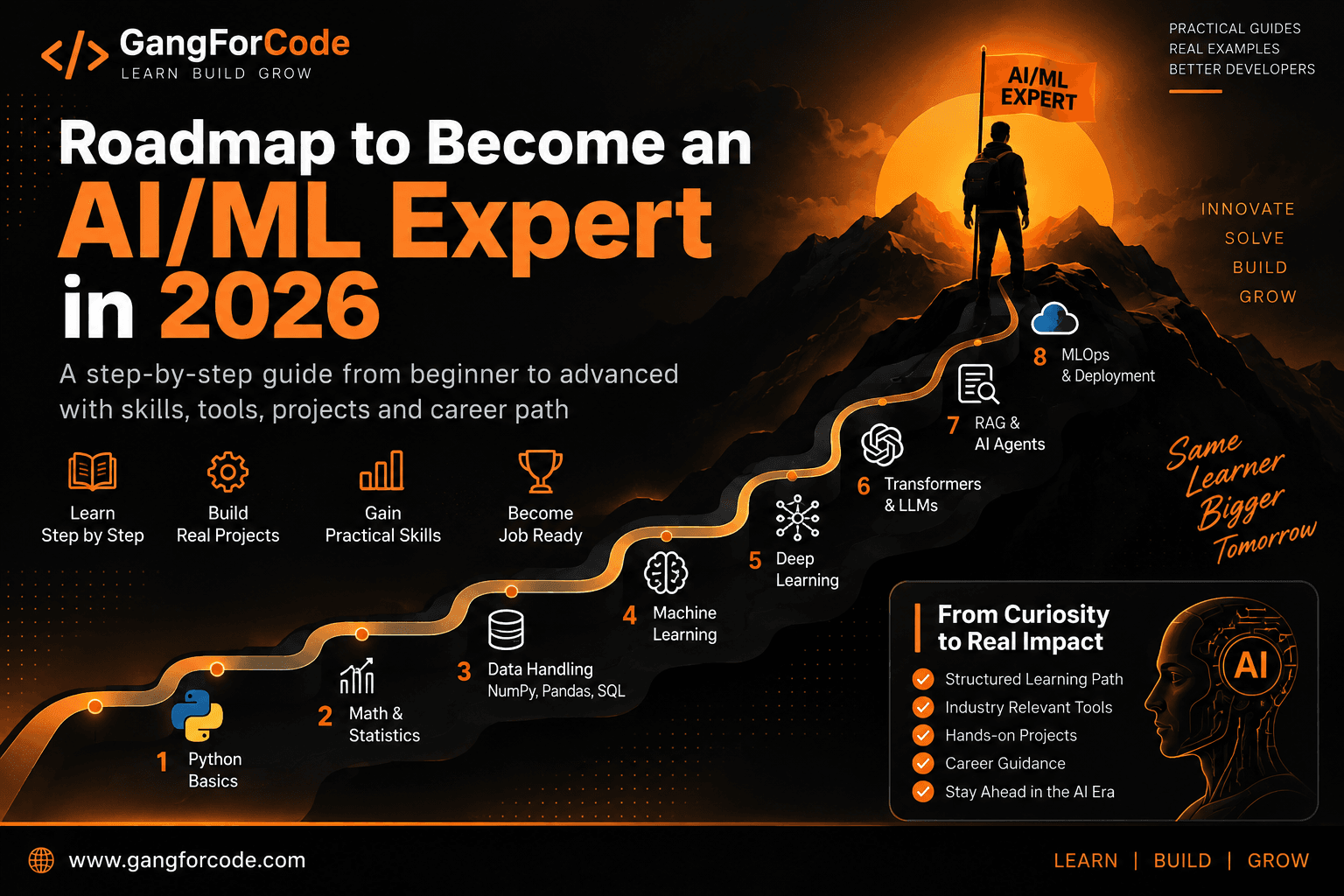
AI/ML Roadmap at a Glance
- Learn Python and software engineering fundamentals
- Build mathematical intuition
- Learn NumPy, pandas, SQL and data visualization
- Master classical machine learning
- Learn model evaluation and experimentation
- Study deep learning and neural networks
- Understand transformers and modern NLP
- Learn embeddings, vector search and RAG
- Build LLM applications and AI agents
- Learn deployment, MLOps and production architecture
- Build real projects and a public portfolio
- Choose a specialization and go deep
Step 1: Learn Python Properly
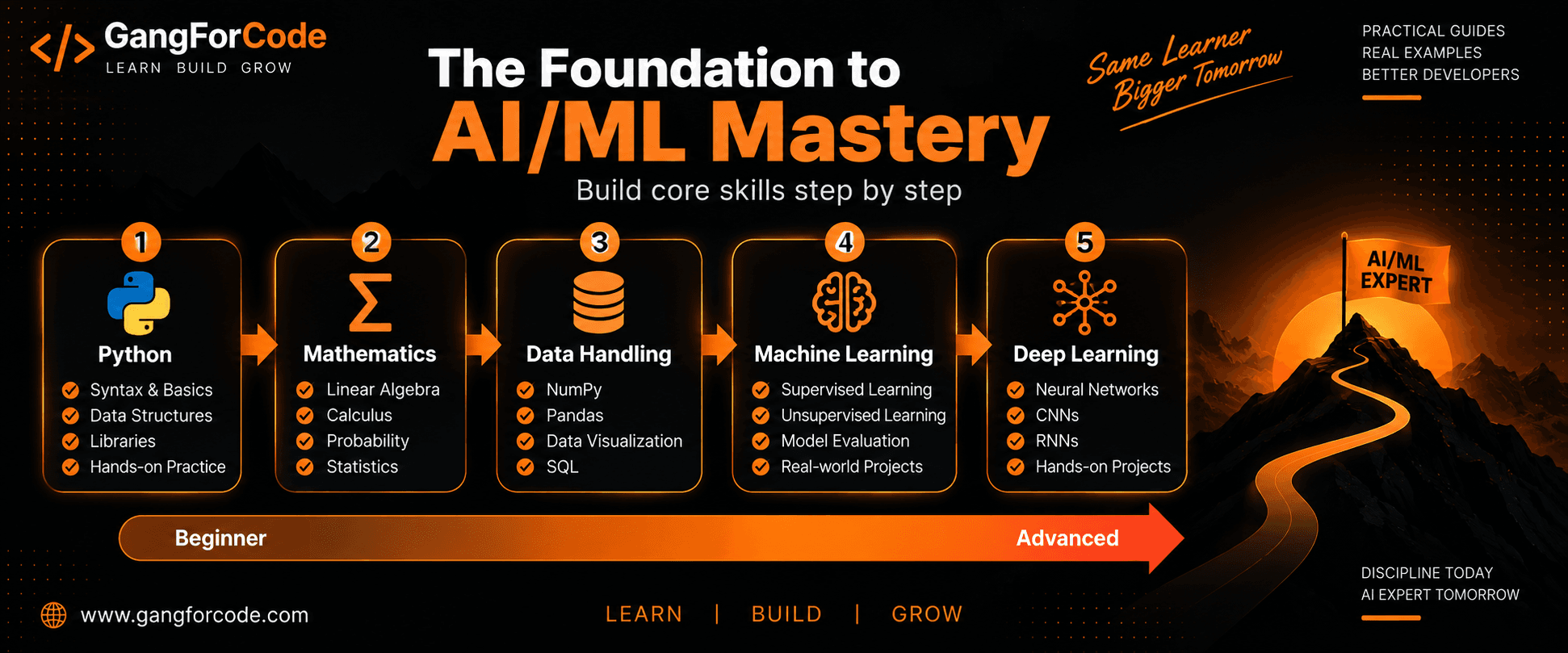
Python is one of the most widely used languages for applied AI and machine learning. But learning only Python syntax is not enough. You should be comfortable writing maintainable software.
Python topics to learn
- Variables, functions and control flow
- Lists, tuples, sets and dictionaries
- Object-oriented programming
- Modules and packages
- Exceptions and error handling
- File handling
- Virtual environments and dependency management
- Iterators and generators
- Decorators
- Type hints
- Testing with pytest
- Logging and debugging
- Concurrency basics
For AI/ML work, also learn how Python projects are structured, how dependencies are managed, and how to build reusable modules instead of putting an entire experiment into one notebook.
If you are already comfortable with Python, do not spend months repeating beginner exercises. Move quickly into data processing and machine learning while filling gaps as they appear.
Step 2: Learn the Mathematics You Actually Need
You do not need to become a mathematician before starting machine learning. However, understanding the mathematics behind common algorithms makes it much easier to reason about models, loss functions, optimization and evaluation.
Linear algebra
Focus on:
- Vectors and matrices
- Matrix multiplication
- Dot products
- Transpose and inverse
- Eigenvalues and eigenvectors
- Vector spaces
Linear algebra becomes especially important when learning embeddings, neural networks and transformers.
Probability and statistics
Learn:
- Mean, median and variance
- Probability distributions
- Conditional probability
- Bayes’ theorem
- Expected value
- Correlation and covariance
- Sampling
- Confidence intervals
- Hypothesis testing
Calculus and optimization
You mainly need enough calculus to understand derivatives, gradients, partial derivatives and gradient-based optimization.
Then connect the concepts to machine learning: a model produces an error, a loss function measures that error, and optimization algorithms adjust model parameters to reduce it.
Step 3: Master Data Handling
Machine learning is not just about choosing an algorithm. A large portion of practical work involves obtaining, cleaning, transforming and validating data.
Learn NumPy
NumPy gives you the numerical computing foundation used by much of the Python data ecosystem. Understand arrays, dimensions, broadcasting, vectorized operations and matrix operations.
Learn pandas
With pandas, practice:
- Reading CSV and JSON files
- Filtering and sorting
- Handling missing values
- Grouping and aggregation
- Merging datasets
- Feature transformation
- Date and time operations
Learn SQL
AI engineers frequently work with data stored outside notebooks. SQL is therefore a core engineering skill rather than an optional extra.
Learn SELECT queries, joins, grouping, window functions, subqueries, indexes and query optimization.
Step 4: Learn Classical Machine Learning
Before jumping directly into LLMs, understand the foundations of machine learning.
Supervised learning
Start with:
- Linear regression
- Logistic regression
- Decision trees
- Random forests
- Gradient boosting
- Support vector machines
- k-nearest neighbors
Unsupervised learning
- k-means clustering
- Hierarchical clustering
- Principal Component Analysis
- Dimensionality reduction
Do not focus only on calling fit() and predict(). Understand what each algorithm is trying to optimize, what assumptions it makes, and where it tends to fail.
Step 5: Learn the Complete ML Workflow
A strong ML engineer understands the complete lifecycle of a model.
- Define the business or engineering problem
- Collect data
- Clean and validate data
- Explore the dataset
- Engineer features
- Split data correctly
- Train a baseline
- Evaluate the model
- Tune hyperparameters
- Test on unseen data
- Deploy the model
- Monitor performance
Understand data leakage
Data leakage occurs when information that should not be available during training influences the model. It can produce impressive validation results while causing poor real-world performance.
Learning to recognize leakage, overfitting and distribution shifts is more valuable than memorizing dozens of algorithms.
Step 6: Learn Model Evaluation
Different problems require different metrics.
| Problem | Useful Metrics |
|---|---|
| Regression | MAE, MSE, RMSE, R² |
| Binary classification | Precision, recall, F1, ROC-AUC, PR-AUC |
| Multiclass classification | Accuracy, macro F1, weighted F1 |
| Ranking/search | Precision@K, Recall@K, MRR, NDCG |
| Generative AI | Task-specific quality, groundedness, relevance, latency and cost |
For production AI systems, model quality is only one dimension. You should also consider latency, cost, reliability, safety and user experience.
Step 7: Learn Deep Learning
Once classical machine learning makes sense, move into neural networks.
Core deep learning concepts
- Neurons and layers
- Activation functions
- Forward propagation
- Backpropagation
- Loss functions
- Gradient descent
- Learning rates
- Batch size
- Regularization
- Dropout
- Batch normalization
- Training and validation loops
Learn at least one major deep learning framework, such as PyTorch. You should be able to define a model, train it, inspect losses, evaluate it and save/load checkpoints.
Step 8: Understand CNNs, Sequence Models and Transformers
You don’t need to become a specialist in every neural architecture, but understanding how major architectures evolved gives you useful intuition.
CNNs
Convolutional neural networks are especially associated with computer vision. Learn convolution, kernels, feature maps, pooling and common image-classification architectures.
Sequence models
Understand the motivation behind recurrent neural networks, LSTMs and GRUs, including the challenges of modeling long-range dependencies.
Transformers
Transformers changed modern NLP and became the foundation for many large language models. Learn:
- Tokenization
- Embeddings
- Positional information
- Self-attention
- Multi-head attention
- Encoder and decoder architectures
- Autoregressive generation
- Pretraining and fine-tuning
At this stage, you should be able to explain at a high level why attention allows a model to relate different tokens in a sequence.
Step 9: Move Into Generative AI and LLMs
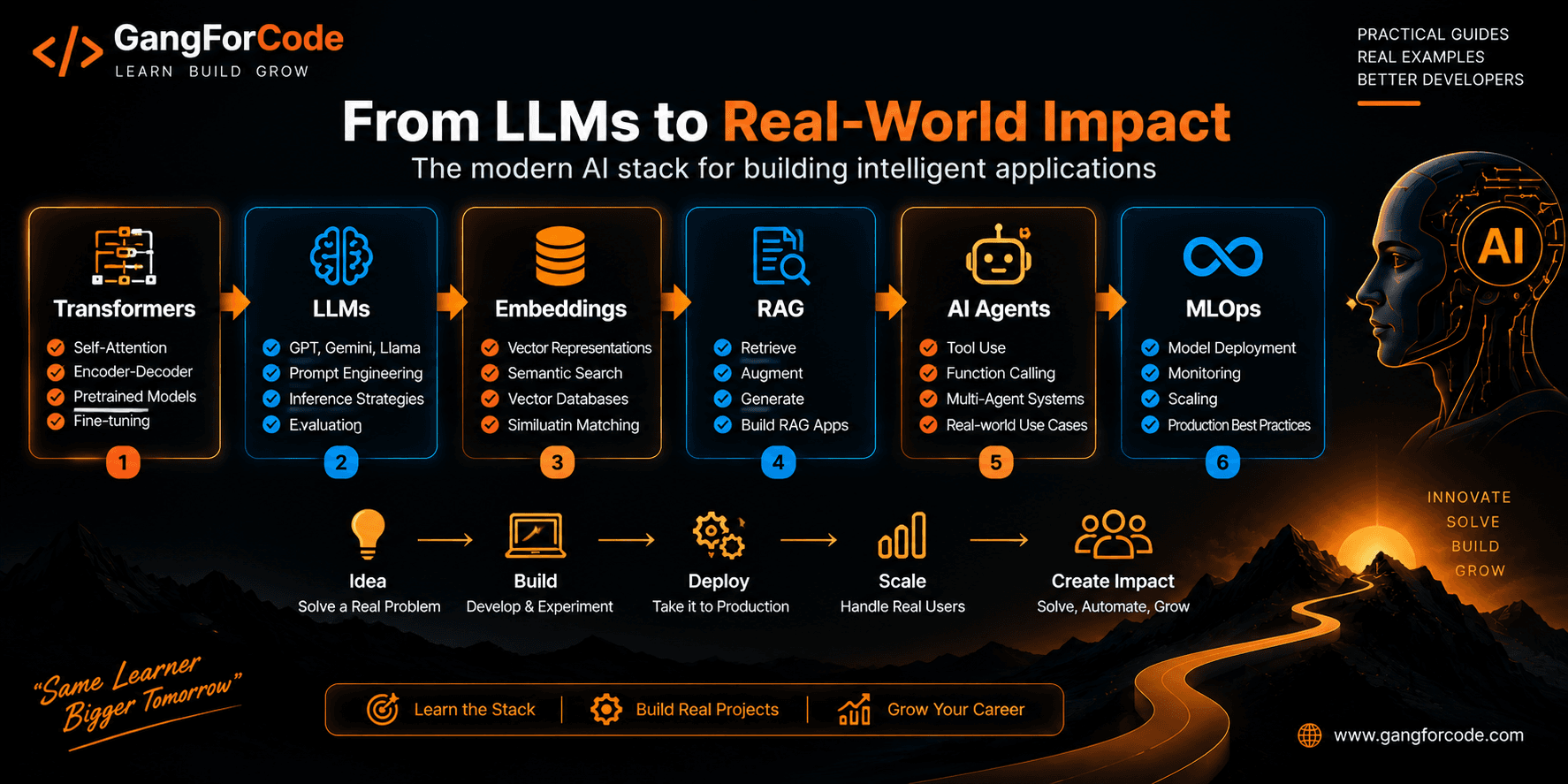
After learning the fundamentals, modern generative AI becomes much easier to understand.
Learn the major concepts:
- Large language models
- Prompt design
- System and user instructions
- Context windows
- Temperature and sampling
- Structured output
- Function/tool calling
- Embeddings
- Fine-tuning
- Inference
- Model evaluation
Do not treat prompt engineering as the entire AI skill set. A production AI engineer also needs data, retrieval, evaluation, backend engineering, security and observability.
Step 10: Learn Embeddings and RAG
Retrieval-Augmented Generation, or RAG, is one of the most practical patterns for building applications around language models.
A typical RAG pipeline looks like this:
- Collect documents
- Clean and split them into chunks
- Generate embeddings
- Store vectors in a vector database
- Retrieve relevant chunks for a user query
- Provide the retrieved context to the language model
- Generate an answer
- Evaluate retrieval and generation quality
Learn about chunking, embedding models, vector similarity, metadata filtering, hybrid search, reranking and retrieval evaluation.
GangForCode already has content around RAG and LangGraph, so this is an area where you can build practical projects and connect your learning to existing material.
Step 11: Learn AI Agents and Tool Calling
The next layer is building systems where an AI model can use tools rather than simply returning text.
An agent-style application may:
- Interpret a task
- Decide which tool is useful
- Call an API
- Query a database
- Search documents
- Run a calculation
- Use the result to continue the workflow
Learn tool calling, state management, agent loops, guardrails, retries, human approval and evaluation.
You can then explore frameworks such as LangGraph, LangChain4j and Spring AI based on your preferred programming ecosystem.
Step 12: Learn AI Engineering With APIs and Backend Systems
AI models rarely exist alone in production. They are usually part of an application.
Learn how to expose AI capabilities through APIs using technologies such as FastAPI or Spring Boot. Understand authentication, rate limiting, asynchronous processing, streaming responses, caching and error handling.
For example, a production RAG application might contain:
User
  ↓
Frontend
  ↓
API Gateway
  ↓
Application Service
  ├── Authentication
  ├── Retrieval
  ├── Vector Database
  ├── LLM Provider
  └── Observability
  ↓
Response
This is where traditional software engineering becomes a major advantage for developers entering AI.
Step 13: Learn MLOps and Production Deployment
A model that works in a notebook is not automatically a production system.
Learn:
- Docker
- Linux fundamentals
- Git and CI/CD
- Cloud fundamentals
- Model serving
- Experiment tracking
- Model and data versioning
- Monitoring
- Logging
- Tracing
- Performance testing
For generative AI applications, also monitor token usage, latency, failure rates, retrieval quality and cost.
Step 14: Build Projects Instead of Only Watching Tutorials
The fastest way to discover gaps in your knowledge is to build complete projects.
Beginner project
House Price Prediction
Use pandas and scikit-learn to clean a dataset, train regression models, evaluate them and expose predictions through an API.
Intermediate project
Customer Churn Prediction API
Build a complete ML pipeline, expose the model through FastAPI, containerize it and add basic monitoring.
Advanced project
Document RAG Assistant
Build a document ingestion pipeline, embeddings, vector search, retrieval, LLM generation, citations and evaluation.
Production-oriented project
AI Interview Evaluation Platform
Combine a web frontend, backend APIs, speech or text processing, an LLM, structured evaluation, database storage and monitoring. A project like this demonstrates both AI knowledge and software engineering ability.
Step 15: Build a Portfolio That Demonstrates Skills
Your portfolio should demonstrate what you can build, not simply list technologies.
For every serious project, document:
- Problem statement
- Architecture
- Technology choices
- Dataset or knowledge source
- Model selection
- Evaluation methodology
- Failure cases
- Performance and cost
- Deployment approach
- Future improvements
Include a GitHub repository with a useful README and, where possible, a live demonstration.
AI/ML Learning Roadmap by Stage
| Stage | Focus | Typical Outcome |
|---|---|---|
| 1 | Python + software engineering | Write reliable Python applications |
| 2 | Math + statistics | Understand model fundamentals |
| 3 | Data engineering basics | Prepare and analyze datasets |
| 4 | Classical ML | Build and evaluate predictive models |
| 5 | Deep learning | Train neural networks |
| 6 | Transformers + LLMs | Understand modern generative AI |
| 7 | RAG + agents | Build useful AI applications |
| 8 | MLOps + deployment | Operate AI systems in production |
| 9 | Specialization | Develop deep expertise in a target area |
How Long Does It Take to Become Good at AI/ML?
There is no universal timeline because the starting point and desired role matter. Someone who already has strong programming and backend experience can usually move through software fundamentals faster than someone starting from scratch.
A practical progression is to think in terms of capabilities rather than a fixed number of months:
- Foundation: Python, mathematics and data
- ML capability: classical algorithms and evaluation
- Deep learning capability: neural networks and transformers
- Applied AI capability: RAG, tool calling and LLM applications
- Production capability: deployment, monitoring and system design
- Specialization: research, ML engineering, computer vision, NLP, GenAI or another area
Consistent hands-on practice is more useful than trying to finish a fixed number of courses.
Common Mistakes to Avoid
1. Learning every framework at once
You do not need five agent frameworks, three vector databases and every cloud provider. Learn the underlying concepts first and then choose tools for your projects.
2. Skipping mathematics completely
You can build an API around an existing model without advanced mathematics, but deeper ML work becomes harder if you cannot reason about probability, vectors, gradients and optimization.
3. Only watching courses
Courses provide structure, but projects expose the gaps. Build something after every major learning stage.
4. Ignoring evaluation
A demo that produces impressive answers is not automatically a reliable AI system. Define what good output means and test it.
5. Treating AI as separate from software engineering
Authentication, databases, APIs, testing, caching, observability and deployment still matter when the application contains an LLM.
Recommended Technology Stack
A practical stack for an applied AI/ML engineer can look like this:
- Language: Python
- Data: NumPy, pandas, SQL
- ML: scikit-learn
- Deep learning: PyTorch
- LLMs: Gemini, OpenAI and other model APIs
- RAG: embeddings + vector database + retrieval pipeline
- Agent workflows: LangGraph or another suitable orchestration framework
- Java ecosystem: Spring AI and LangChain4j
- Backend: FastAPI or Spring Boot
- Deployment: Docker + cloud platform
- Engineering: Git, testing, CI/CD and observability
The exact tools will change over time. The durable skills are programming, data, statistics, model understanding, evaluation and production engineering.
Final AI/ML Roadmap
If you want a simple sequence to follow, use this order:
- Python and software engineering
- Linear algebra, probability and statistics
- NumPy, pandas and SQL
- Classical machine learning
- Model evaluation and experimentation
- PyTorch and deep learning
- CNNs and sequence models
- Transformers and attention
- LLMs and generative AI
- Embeddings and vector search
- RAG
- Tool calling and AI agents
- FastAPI/Spring Boot and AI application architecture
- Docker, cloud and MLOps
- Evaluation, monitoring and responsible AI practices
- Real-world projects and specialization
The goal is not to collect certificates or memorize every AI framework. The goal is to be able to take an ambiguous problem, select an appropriate approach, build a working system, evaluate it honestly, deploy it reliably and explain the engineering decisions behind it.
Related GangForCode Tutorials
- Building an Interactive AI Console in Java with LangChain4j and Gemini
- Multithreading vs Multiprocessing in Python
- LangGraph Tutorial with Gemini for Beginners
- How LangGraph Works Internally
- Build Your First MCP Server with Spring Boot and Spring AI
Frequently Asked Questions
Can I learn AI/ML without a computer science degree?
Yes. A formal degree can be useful, but practical AI/ML skills can be developed through structured learning, mathematics, programming practice and projects. Focus on demonstrating your capabilities.
Should I learn Python before machine learning?
Yes. You should be comfortable enough with Python to manipulate data, write functions, use libraries, debug programs and structure small projects before going deeply into machine learning.
Should I learn machine learning before generative AI?
Learning classical ML first provides valuable foundations, particularly around data, training, evaluation and generalization. However, developers can begin experimenting with LLM APIs earlier while learning the underlying ML concepts in parallel.
Do I need advanced mathematics for LLM application development?
Not necessarily. Building applications with existing LLM APIs requires less mathematics than developing or researching models. Deeper mathematics becomes increasingly important as you move toward model training, optimization and research.
What should I build first?
Start with a small end-to-end project. A prediction API is a good ML foundation, followed by a document-based RAG assistant and then a tool-using AI application. Each project should introduce one new layer of complexity.
3 thoughts on “Roadmap to Become an AI/ML Expert in 2026: From Beginner to Advanced”