
Data is the foundation of data analytics. Before analyzing or visualizing anything, we must first understand where data comes from (source of data) and what type of data it is (nature of data).
This article explains both concepts in a simple, beginner-friendly way, with real-life examples.
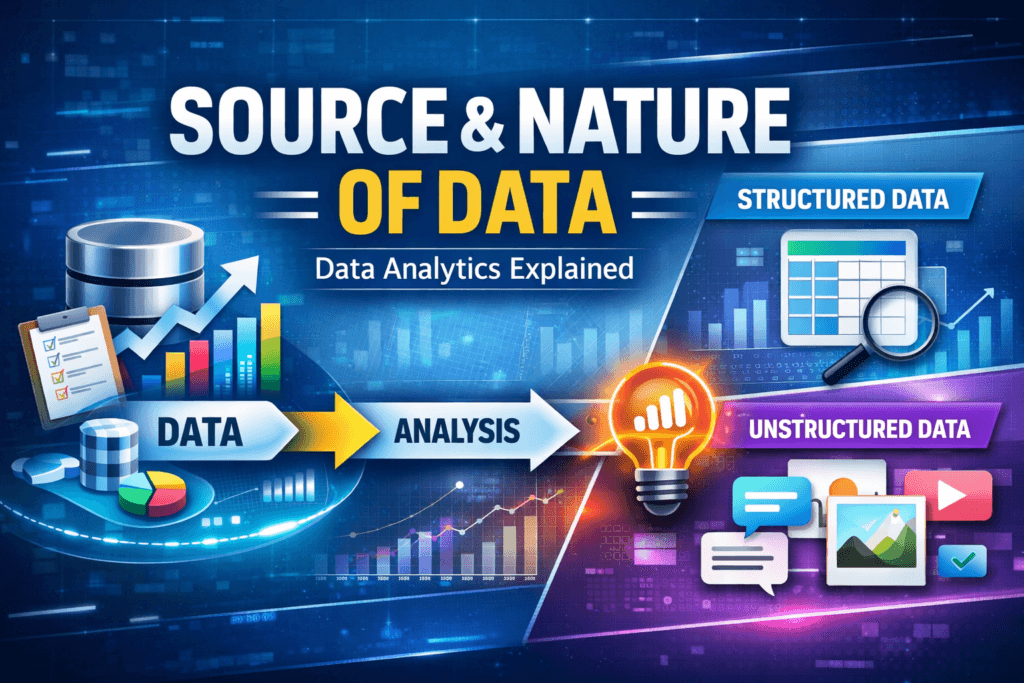
What Is Data?
Data is a collection of facts, figures, observations, or measurements.
Examples:
- Student marks
- Product prices
- Website visits
- Weather temperature
- Customer feedback
In data analytics, data is collected, cleaned, analyzed, and transformed into useful insights for decision-making.
Source of Data
The source of data refers to where the data is collected from.
Data sources are mainly divided into two types:
1. Primary Data
Primary data is data collected first-hand by the analyst for a specific purpose.
Examples of Primary Data
- Online surveys (Google Forms)
- Interviews with customers
- Experiments
- Direct observations
Real-Life Example
A company collects feedback directly from customers after a product purchase.
Advantages
- Accurate and reliable
- Collected for a specific goal
- Up-to-date information
Disadvantages
- Time-consuming
- Costly
- Requires planning
2. Secondary Data
Secondary data is data that has already been collected by someone else and is reused for analysis.
Examples of Secondary Data
- Government reports
- Company databases
- Research papers
- Public datasets (Kaggle, World Bank)
Real-Life Example
Using census data from a government website for population analysis.
Advantages
- Easily available
- Saves time and cost
- Large volume of data
Disadvantages
- May not be fully relevant
- Data may be outdated
- Less control over data quality
Nature of Data
The nature of data describes how data is structured and what form it takes.
It helps analysts choose the correct tools and techniques.
Types of Data Based on Structure
1. Structured Data
Structured data is organized in rows and columns, like a table.
Examples
- Excel sheets
- SQL databases
- Student records
Characteristics
- Easy to store
- Easy to analyze
- Fixed format
2. Unstructured Data
Unstructured data has no fixed format.
Examples
- Images
- Videos
- Social media posts
- Emails
Characteristics
- Difficult to analyze
- Large volume
- Requires advanced tools
3. Semi-Structured Data
Semi-structured data is partially organized.
Examples
- JSON files
- XML files
- Log files
Characteristics
- Flexible format
- Easier than unstructured data
- Widely used in web applications
Types of Data Based on Nature (Values)
1. Qualitative Data (Categorical Data)
This data describes qualities or characteristics.
Examples
- Gender
- Color
- Customer feedback (Good/Bad)
2. Quantitative Data (Numerical Data)
This data is numeric and measurable.
Examples
- Age
- Salary
- Number of products sold
Why Understanding Source and Nature of Data Is Important
✔ Helps choose correct analytics tools
✔ Improves data accuracy
✔ Saves time and effort
✔ Enables better decision-making
✔ Essential for beginners in data analytics
Summary Table
| Aspect | Description |
|---|---|
| Source of Data | Primary and Secondary |
| Nature of Data | Structured, Unstructured, Semi-Structured |
| Data Type | Qualitative and Quantitative |
| Importance | Accurate analysis and insights |
Final Thoughts
Understanding the source and nature of data is the first and most important step in data analytics.
Before applying machine learning, visualization, or dashboards, always ask:
👉 Where did this data come from?
👉 What type of data am I working with?
Mastering these basics will make your journey in data analytics smooth and successful 🚀