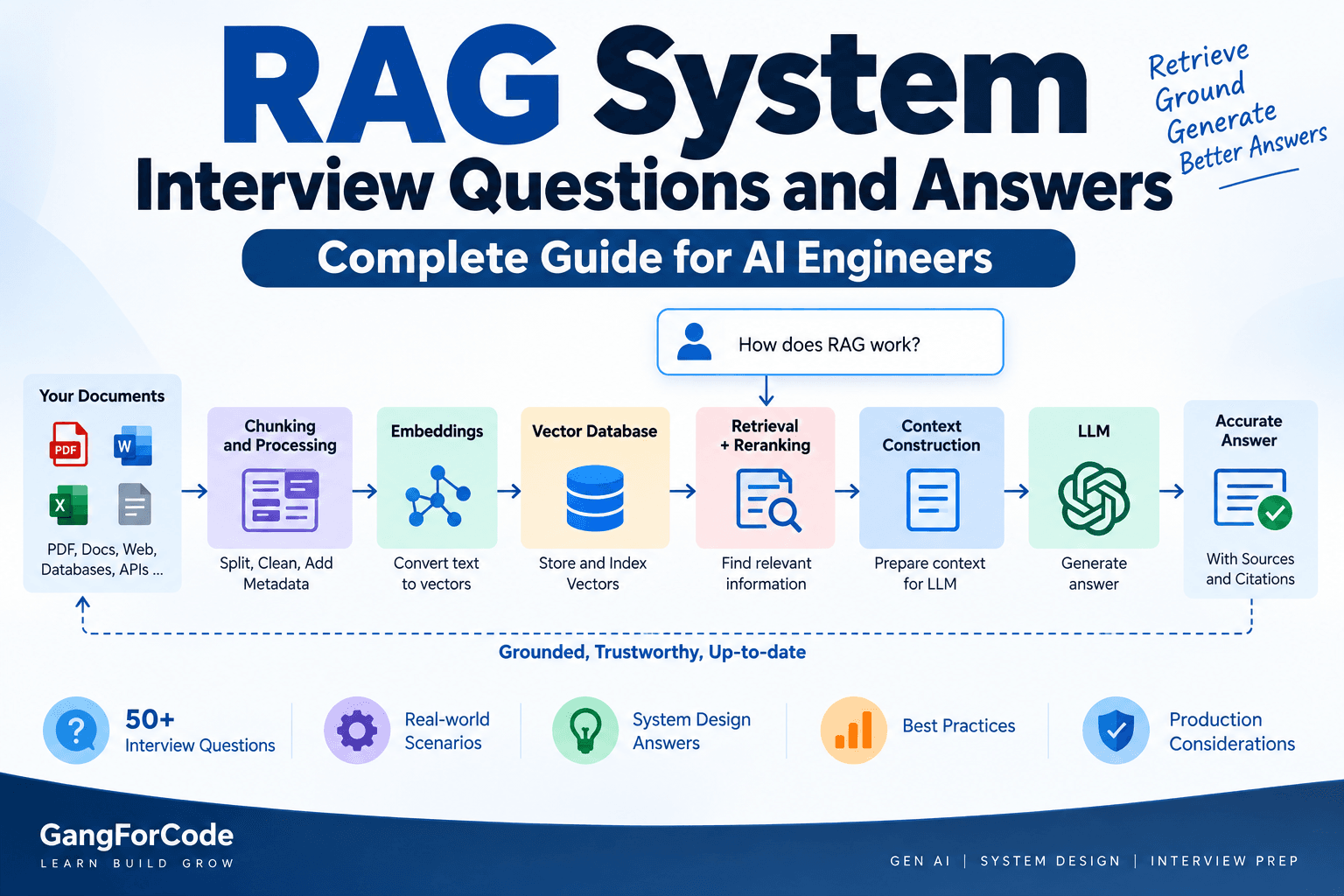
Retrieval-Augmented Generation (RAG) is one of the most important architectures for building production Generative AI applications. It connects a large language model (LLM) to external knowledge so that answers can be grounded in documents, databases, APIs, or other data sources.
For an AI Engineer, GenAI Engineer, LLM Engineer, or Machine Learning Engineer interview, knowing only the definition of RAG is not enough. Interviewers often go deeper into the complete pipeline: ingestion, parsing, chunking, embeddings, vector search, hybrid retrieval, reranking, context construction, prompt design, evaluation, security, latency, cost, and system design.
This guide focuses specifically on RAG system interview questions, including architecture, troubleshooting, production design, and scenario-based questions.
RAG Architecture at a Glance
A typical RAG application has two major paths: an offline ingestion pipeline and an online query pipeline.
Offline:
Documents → Parsing → Chunking → Metadata → Embeddings → Vector Store

Online:
User Query → Query Processing → Retrieval → Reranking → Context → LLM → Answer
For a broader learning path covering LLMs, RAG, and AI agents, see the AI/ML roadmap. You can also review our RAG interview questions guide for additional interview preparation.
Basic RAG System Interview Questions
1. What is RAG?
RAG stands for Retrieval-Augmented Generation. It retrieves relevant external information and supplies it to an LLM as context before generating an answer. This allows the application to use knowledge that may not be contained in the model’s training data.
2. Why is RAG needed if an LLM already knows many things?
LLMs can have outdated, incomplete, or non-private knowledge. RAG allows an application to retrieve current, domain-specific, or private information at query time without retraining the base model.
3. Explain the complete RAG architecture.
The common flow is: document ingestion, parsing, chunking, metadata enrichment, embedding generation, vector indexing, query processing, retrieval, optional reranking, context assembly, prompt construction, and LLM generation. Production systems also add authentication, observability, evaluation, caching, and failure handling.
4. What are the main components of a RAG system?
The main components are data sources, document loaders or parsers, chunking logic, an embedding model, a vector or hybrid search layer, a retriever, optional reranker, prompt builder, LLM, and evaluation and monitoring components.
5. What is the difference between the indexing pipeline and the query pipeline?
The indexing pipeline prepares knowledge before users search: documents are parsed, chunked, embedded, and stored. The query pipeline runs at request time: the user query is processed, relevant chunks are retrieved and reranked, and the selected context is sent to the LLM.
6. What happens during document ingestion?
Raw documents are loaded, parsed, cleaned, split into chunks, enriched with metadata, embedded, and stored in the retrieval system. A robust pipeline also tracks document IDs, versions, timestamps, and access permissions.
7. What is document chunking?
Chunking splits large documents into smaller retrieval units. Smaller units usually improve retrieval precision, while larger units preserve more context. Good chunking balances both goals.
8. How do you choose chunk size?
There is no universal value. Choose chunk size based on document structure, query patterns, embedding model, context limits, and evaluation results. Start with a sensible baseline, then tune it using real retrieval tests rather than guessing.
9. What is chunk overlap?
Chunk overlap keeps some text in common between adjacent chunks. It can preserve information that crosses chunk boundaries, but excessive overlap increases storage, duplication, and retrieval noise.
10. What chunking strategies are commonly used?
Common strategies include fixed-size, sentence-based, paragraph-based, recursive, semantic, and structure-aware chunking. Technical documentation often benefits from preserving headings, code blocks, lists, tables, and section boundaries.
Embeddings and Vector Search Questions
11. What are embeddings?
Embeddings are numerical vector representations of text. Similar meanings are represented by vectors that are often close in vector space, enabling semantic retrieval.
12. How does vector similarity work?
The query is converted into an embedding and compared with stored document vectors. Common similarity measures include cosine similarity, dot product, and Euclidean distance. The system uses those scores to rank candidate chunks.
13. What is a vector database?
A vector database stores embeddings and supports efficient nearest-neighbor search. A record commonly contains the chunk text, vector, identifier, and metadata used for filtering.
14. Which vector databases are commonly used?
Examples include Pinecone, Qdrant, Weaviate, Milvus, Chroma, and PostgreSQL with pgvector. Elasticsearch and OpenSearch can also support vector and hybrid retrieval workflows.
15. What is semantic search?
Semantic search retrieves information based on meaning rather than exact word matching. It can find a relevant passage even when the query and document use different wording.
16. What is keyword search?
Keyword search matches terms using lexical techniques. It remains valuable for exact identifiers, error codes, names, version numbers, and technical phrases.
17. What is hybrid search?
Hybrid search combines lexical and semantic retrieval. One branch can find exact terms while the other captures meaning, and the results can then be fused or reranked.
18. What is top-K retrieval?
Top-K retrieval means selecting the K highest-ranked candidates from the retriever. A small K may hurt recall, while a very large K can introduce irrelevant context and increase cost.
19. What is reranking?
Reranking is a second-stage relevance step. For example, a fast retriever may return 20 candidates and a cross-encoder or other reranker may reduce them to the five most useful chunks for generation.
20. Why is reranking useful?
Embedding similarity is a strong first filter but is not always sufficient for fine-grained relevance. Reranking can consider the query and candidate passage together and improve the final context quality.
Advanced Retrieval Questions
21. What is metadata filtering?
Metadata filtering restricts retrieval using attributes such as department, tenant, date, document type, region, or access level. It is particularly important in enterprise systems where users must see only authorized data.
22. What is multi-query retrieval?
The application generates multiple search formulations for the same user intent, retrieves results for each formulation, and combines them. This can increase recall when the same concept appears in documents with different wording.
23. What is query expansion?
Query expansion adds related words or concepts to improve retrieval coverage. It can be implemented using rules, search-specific logic, or an LLM.
24. What is query rewriting?
Query rewriting transforms an ambiguous or conversational question into a clearer retrieval query. For example, a follow-up such as “What about the second one?” may need conversational context before retrieval.
25. What is HyDE?
HyDE, or Hypothetical Document Embeddings, generates a hypothetical answer or document from the query and embeds that generated text for retrieval. The goal is to improve the semantic representation used for searching real documents.
26. What is parent-child retrieval?
Small child chunks are indexed for precise matching while maintaining a relationship with a larger parent section. Retrieval can select a child chunk and then bring back additional parent context for generation.
27. What is contextual retrieval?
Contextual retrieval enriches chunks with enough surrounding information that they remain meaningful when retrieved independently. This is useful when a chunk contains pronouns, references, or section-specific terms that lose meaning outside their original context.
28. How do you handle questions that require multiple documents?
Retrieve evidence from all relevant documents, preserve source metadata, and combine the evidence before generation. Complex queries may benefit from query decomposition, multiple retrieval rounds, or an agent that performs several searches.
29. How do you handle tables and structured documents?
Do not assume every table should be flattened into plain text. Preserve headers and row-column relationships where possible. For highly structured data, storing it in a database and using SQL or another structured retrieval path can be more reliable than text retrieval alone.
30. What is context compression?
Context compression removes irrelevant or redundant material from retrieved passages before they are sent to the LLM. This can reduce token usage and make the evidence easier for the model to process.
RAG Evaluation Interview Questions
31. How do you evaluate a RAG system?
Evaluate retrieval and generation separately. Retrieval evaluation asks whether the correct evidence was found; generation evaluation asks whether the final answer is supported, relevant, correct, and complete. Also measure latency, cost, and failure rates.
32. What retrieval metrics do you know?
Common metrics include precision, recall, hit rate, Mean Reciprocal Rank (MRR), and Normalized Discounted Cumulative Gain (NDCG). The right metric depends on whether you care more about finding all useful evidence or ranking the best evidence first.
33. What is retrieval precision?
Precision measures how much of the retrieved set is relevant. High precision means the retriever returns fewer irrelevant candidates.
34. What is retrieval recall?
Recall measures how much of the relevant evidence the retriever successfully finds. A system with poor recall may fail even when the generation model is strong.
35. What is faithfulness in RAG evaluation?
Faithfulness asks whether the generated answer is supported by the retrieved context rather than invented or contradicted by it.
36. Why should retrieval and generation be evaluated separately?
If retrieval is poor, changing the LLM may not solve the problem. Separating the stages lets you determine whether the failure came from search, ranking, context construction, or answer generation.
Hallucination and Reliability Questions
37. Does RAG eliminate hallucinations?
No. RAG can reduce unsupported answers by supplying relevant evidence, but hallucinations can still occur because of poor retrieval, conflicting context, weak prompts, model behavior, or incorrect source data.
38. How would you reduce hallucinations in RAG?
Improve retrieval quality, use metadata filters and reranking, constrain the prompt to use retrieved evidence, allow the application to abstain when evidence is insufficient, and include citations or other verification mechanisms.
39. What should happen if the answer is not present in the knowledge base?
The system should avoid inventing an answer. A relevance or confidence check can route the request to an abstention response such as “I could not find enough information in the available sources,” or ask the user for clarification.
40. How would you handle conflicting documents?
Use metadata such as effective date, version, authority, tenant, or document type to determine source priority. The retrieval layer should prefer the applicable document rather than asking the LLM to guess which source is current.
RAG vs Fine-Tuning and Long Context
41. RAG vs fine-tuning: what is the difference?
RAG injects external knowledge at inference time. Fine-tuning changes model behavior through additional training. RAG is often useful for changing or private knowledge, while fine-tuning is often useful for specialized behavior, style, or repeated task patterns. Some systems use both.
42. When would you choose RAG over fine-tuning?
RAG is a strong fit when knowledge changes often, source attribution matters, private data must be accessed, or documents need to be updated without retraining the model.
43. Why not put the entire knowledge base into a large-context model?
A large context window does not remove the need to select relevant information. Retrieval can reduce token usage, improve focus, support access control, and make very large knowledge bases manageable.
Production RAG System Design Questions
44. How would you design a production RAG system for company documents?
Start with document connectors and an ingestion pipeline. Parse documents, create structure-aware chunks, attach metadata, generate embeddings, and index them. At query time, authenticate the user, apply permissions, use hybrid retrieval, rerank candidates, assemble a small high-quality context, call the LLM, and return citations. Add caching, monitoring, evaluation, retries, and audit logging.
User
  ↓
API Gateway
  ↓
Authentication / Authorization
  ↓
Query Processing
  ↓
Hybrid Retrieval
  ↓
Reranking
  ↓
Context Builder
  ↓
LLM
  ↓
Answer + Sources
45. How do you secure a RAG system?
Enforce authentication and authorization before retrieval. Use tenant and document-level filters, encrypt data, protect API credentials, audit access, and make sure unauthorized content never enters the LLM context.
46. How do you prevent data leakage in enterprise RAG?
Apply access control at the data and retrieval layers instead of relying only on a prompt instruction. A user should receive only chunks from documents they are allowed to access.
47. How do you handle frequently changing documents?
Use incremental ingestion. Detect changed documents, reprocess only affected chunks, update their embeddings, and retire obsolete versions. Track document and chunk identifiers so updates do not create uncontrolled duplicates.
48. How would you improve RAG latency?
Measure each stage independently. Common optimizations include caching, efficient vector indexes, smaller candidate sets, limited reranking, parallel retrieval paths, query optimization, and streaming LLM responses.
49. How would you reduce RAG cost?
Reduce unnecessary LLM calls and context tokens, cache repeated results, use cost-effective embedding and generation models where appropriate, batch indexing work, and route simple requests to cheaper processing paths.
50. What are common failure points in a RAG pipeline?
Failures can occur during parsing, chunking, embedding, indexing, retrieval, reranking, prompt construction, and generation. Debugging should therefore trace the complete pipeline instead of assuming that every wrong answer is an LLM problem.
Advanced RAG Interview Questions
51. What is agentic RAG?
Agentic RAG allows an agent to decide which tools or retrieval methods to use. A complex request might require vector search, SQL, an API, or multiple searches rather than a single retrieval call.
52. What is Graph RAG?
Graph RAG combines retrieval with graph-based entities and relationships. It can be useful for multi-hop questions where understanding connections between people, products, departments, systems, or other entities matters.
53. What is query decomposition?
Query decomposition breaks a complex question into smaller sub-questions. Each sub-question can be retrieved and processed independently, after which the system combines the evidence.
54. What is the lost-in-the-middle problem?
When a large amount of context is supplied, information in the middle may receive less effective attention than information near the beginning or end. This is another reason to prioritize concise, high-quality evidence instead of simply increasing the number of retrieved chunks.
Scenario-Based RAG Interview Questions
55. Retrieval is poor. What would you check first?
Check query formulation, chunk boundaries, embedding quality, metadata filters, similarity thresholds, retrieval strategy, and the evaluation dataset. If necessary, compare semantic search with hybrid search and add reranking.
56. Retrieval is good but the final answer is wrong. What would you investigate?
Inspect the prompt, context ordering, context length, answer instructions, model choice, and whether the retrieved evidence actually supports the answer. This is usually a generation or context-construction investigation rather than a database investigation.
57. How would you handle follow-up questions in a conversational RAG system?
Maintain conversation state or rewrite the follow-up question into a standalone retrieval query. For example, “What about the second one?” cannot be searched correctly without knowing what “second one” refers to.
58. What if the system returns too many similar chunks?
Use deduplication, diversity-aware retrieval, improved chunking, reranking, or a lower candidate count. Returning five nearly identical chunks is often less useful than returning several complementary pieces of evidence.
59. What if users ask questions that require calculations?
Route calculation-heavy requests to deterministic tools or structured systems where appropriate. A useful architecture may combine RAG with SQL, calculators, APIs, or code execution rather than forcing every task through text retrieval and generation.
60. How would you prove that a RAG change actually improved the system?
Create a fixed evaluation set and compare retrieval and generation metrics before and after the change. Also track latency, cost, and regression cases. A change should be evaluated against representative real-world queries, not just a handful of manually selected examples.
A Practical RAG System Design Answer for Interviews
When an interviewer asks you to design a RAG system, structure your answer in layers:
- Data layer: identify sources such as PDFs, wikis, cloud drives, databases, and APIs.
- Ingestion layer: parse, clean, chunk, enrich with metadata, embed, and index.
- Retrieval layer: authenticate, filter by permissions, use hybrid or semantic retrieval, and rerank.
- Generation layer: build the prompt, provide evidence, generate the answer, and return citations.
- Reliability layer: add evaluation, monitoring, retries, caching, and abstention.
- Security layer: enforce identity, authorization, tenant isolation, and audit logging.
RAG Interview Cheat Sheet
| Topic | What You Should Know |
|---|---|
| RAG | Retrieve evidence and generate an answer grounded in that evidence |
| Chunking | How document structure affects retrieval quality |
| Embeddings | How text is represented as vectors |
| Vector Search | Similarity metrics and nearest-neighbor retrieval |
| Hybrid Search | Combining lexical and semantic retrieval |
| Reranking | Second-stage relevance scoring |
| Metadata | Filtering, versioning, tenant isolation, and permissions |
| Evaluation | Precision, recall, MRR, NDCG, faithfulness, relevance, correctness |
| Security | Authorization must happen before restricted context reaches the model |
| Production | Latency, cost, observability, caching, reliability, and updates |
Final Thoughts
A strong RAG interview answer goes far beyond saying “use a vector database and an LLM.” Interviewers want to see that you understand the complete system: how data is prepared, how relevant evidence is retrieved, how context is selected, how answers are grounded, how quality is measured, and how the application is secured and operated in production.
For senior-level interviews, be prepared to explain the trade-offs between semantic search and hybrid search, small and large chunks, high and low top-K values, RAG and fine-tuning, as well as simple RAG versus agentic or graph-based architectures.